
When Targeting Gets Too Narrow: A Break-Even Lens for selecting Audience Segments
Short practical advise on media targeting decisions:
-
Calculate the “Break-Even Multiplier” Before Spending Instead of asking if a targeting segment will perform better than a broad audience, calculate exactly how much better it needs to be to justify its cost. This “Break-Even Lift” accounts for higher CPMs, data costs, and reduced reach. If a segment requires a 150% performance lift to break even, and your historical best is 20%, that segment is a mathematical non-starter.
-
Avoid the “Narrowness Trap” The performance lift required to break even increases non-linearly as your reach shrinks. The research shows that very narrow segments (reaching 5% or less of your potential audience) often require performance gains of 150% or more. Unless you have a specific, high-margin reason to target that narrowly, broader segments are statistically more likely to be profitable.
-
Use Targeting as a Pre-Campaign Filter, Not Just a Test Most marketers treat audience segments as things to be tested in-market. Instead, use this break-even model as a pre-flight checklist. By sorting candidate segments by their required break-even lift, you can immediately discard those that require “miracle” performance levels, allowing you to focus your budget on segments with a plausible path to ROI.
-
Factor in the “Privacy Tax” on Data Quality Recent privacy changes (like Apple’s ATT) have a disproportionate impact on narrow segments. Lower data quality increases CPMs and decreases the accuracy of targeting, which further pushes up the break-even floor. In high-privacy environments, the math increasingly favors broader targeting because the “targeting tax” is too high for narrow segments to overcome.
Long Version
I keep running into the same problem when setting up paid media campaigns: there are hundreds of audience segments, but no clear way to know which ones are worth testing. This paper by Ahmadi et al. (2023) is the first I have seen that formalizes the trade-off between reach, cost, and performance into a single break-even metric. It turns “Which segment should I pick?” into “What lift do I need to make targeting at least as profitable as not targeting?”
Below is a practical walkthrough of that idea, plus a simple calculator I will use going forward.
The core idea: break-even performance
Targeting can help because it may increase click-through rate (CTR), conversion rate (CR), or margin per conversion. But it can hurt because you pay more and reach fewer people. The paper models this trade-off and derives a break-even multiplier: the combined lift you would need in CTR * CR * margin so that targeting is as profitable as no targeting.
In the paper’s Spotify study, roughly half of the available segments required more than a 100% CTR lift to break even, already a tall ask in real campaigns. Even worse, very narrow segments (<= 5% reach) required increases well above 150%. The main message: narrowness is expensive, and the required lift rises non-linearly as reach shrinks.
The authors also show that when data quality drops (for example, after Apple’s App Tracking Transparency changes), narrow segments are hit harder: higher CPMs and lower CTRs compared to broad segments.
A simple break-even calculator
To use the model in practice, you need baseline performance (no targeting), expected reach share of the target segment, and CPMs. The break-even lift can be computed by equating profit under targeting to profit under no targeting.
Here is a minimal R version you can paste into a notebook:
# Minimal break-even calculator
break_even_lift <- function(ctr0, cr0, margin0, cpm0,
                            reach_share, cpm_target, data_cost = 0,
                            impressions = 1e6) {
  p0 <- impressions * ctr0 * cr0 * margin0 - (cpm0 * impressions / 1000)
  denom <- impressions * reach_share * ctr0 * cr0 * margin0
  cost_target <- (cpm_target + data_cost) * impressions * reach_share / 1000
  lift <- (p0 + cost_target) / denom
  lift
}

# Example baseline (close to the paper's illustrative values)
ctr0 <- 0.01
cr0 <- 0.02
margin0 <- 200
cpm0 <- 11

segments <- data.frame(
  segment = c("broad", "mid", "narrow"),
  reach_share = c(0.50, 0.20, 0.05),
  cpm_target = c(11, 11, 11),
  data_cost = c(1.0, 1.0, 1.0)
)

segments$break_even_lift <- mapply(
  break_even_lift,
  ctr0 = ctr0,
  cr0 = cr0,
  margin0 = margin0,
  cpm0 = cpm0,
  reach_share = segments$reach_share,
  cpm_target = segments$cpm_target,
  data_cost = segments$data_cost
)
Plot: break-even lift vs. reach
This plot shows how the minimum required lift explodes as reach shrinks.
library(ggplot2)

reach <- seq(0.05, 1.0, length.out = 200)

plot_df <- data.frame(
  reach_share = reach,
  break_even_lift = sapply(reach, function(r) {
    break_even_lift(
      ctr0 = ctr0,
      cr0 = cr0,
      margin0 = margin0,
      cpm0 = cpm0,
      reach_share = r,
      cpm_target = 11,
      data_cost = 1.0
    )
  })
)

ggplot(plot_df, aes(x = reach_share, y = break_even_lift)) +
  geom_line(color = "#1f77b4", linewidth = 1) +
  geom_hline(yintercept = 2.0, linetype = "dashed", color = "gray60") +
  annotate("text", x = 0.95, y = 2.05, label = "100% lift",
           hjust = 1, vjust= 1.5, size = 3, color = "gray50") +
  labs(
    title = "Break-even performance increases non-linearly as reach shrinks",
    x = "Reach share of target segment",
    y = "Required combined lift (CTR * CR * margin)"
  ) +
  theme_minimal(base_size = 14)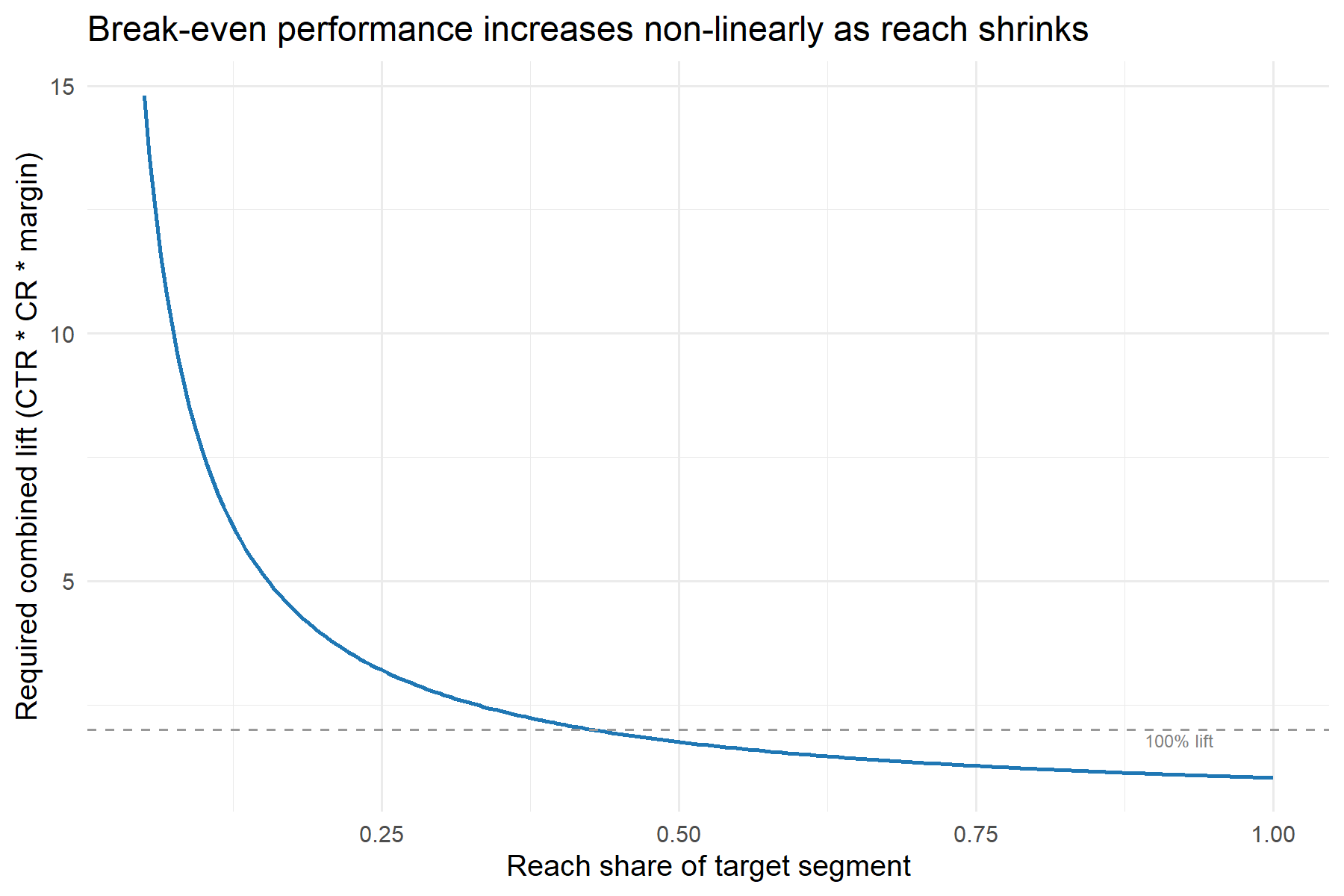
Recommendations
- Sort candidate segments by break-even lift before running tests/campaigns.
- Prioritize broader segments unless I can justify a very large performance gain.
- Treat data quality shifts (like privacy changes) as a direct hit to narrow-segment ROI.
The most useful takeaway is that this gives a pre-campaign filter. Instead of throwing money at dozens of segments, you can focus on the handful that require plausible lifts.
Limitations to keep in mind
The model is only as good as the inputs. If baseline CTR or CR or margin estimates are wrong, the lift will be off. It also assumes a single combined lift in performance rather than separating CTR, CR, and margin effects. That said, as a first-pass filter, it is much better than guessing.
Targeting Calculator
Quickly calculate if targeting is beneficial
Resources
Ahmadi, Abou Nabout, Skiera, Maleki, Fladenhofer (2023), “Overwhelming targeting options: Selecting audience segments for online advertising,” International Journal of Research in Marketing